Home · Abroad
A goods gap is not a verdict
Trade statistics record transactions between residents of the United Kingdom and residents of everywhere else. They are an account of flows, published by the Office for National Statistics. They are not a moral score, and a deficit is not the same object as a household that has overspent its wages.
11 September 2026 · About 8 minutes · Fangotelyx desk, Lynemouth
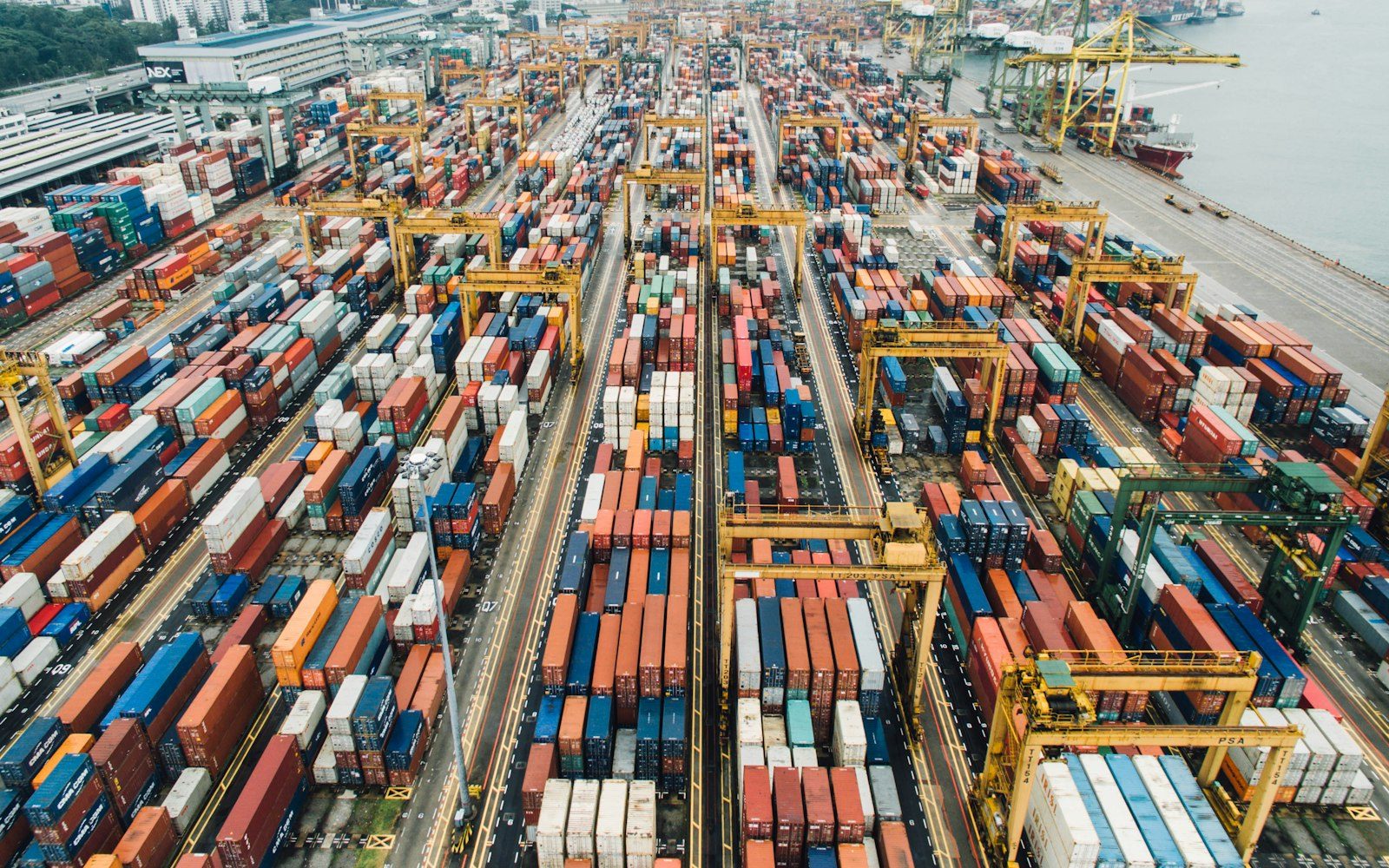
Containers make goods trade visible. A large share of Britain’s overseas earnings does not fit in a box.
Goods and services are both trade
Goods are physical: machinery, cars, food, fuels, chemicals. Services are everything else sold across the border: finance, law, consulting, education, tourism, intellectual property, transport. A visitor who flies in and stays in a British hotel is a services export. A British household that takes a holiday abroad is a services import. The port photograph is a fair picture of goods. It is a poor picture of the services balance, which is where the UK has, for many years, tended to earn more than it spends.
The trade balance is exports minus imports. A negative number is a deficit. A positive number is a surplus. You can compute it for goods alone, for services alone, or for both. Quoting the goods deficit as if it were the whole of trade ignores the services line, which is often in the other direction. The monthly trade release is also noisy: erratics such as aircraft or precious metals can swing a month, which is why the ONS often invites you to look through them.
The current account is wider than trade
The current account of the balance of payments adds three families of flow.
- Trade in goods and services, as above.
- Primary income. Wages earned across borders, and, much larger for the UK, investment income: interest, dividends, and profits paid between UK residents and overseas residents. A British pension fund holding foreign shares receives income. A foreign owner of a UK factory receives profits the other way.
- Secondary income. Transfers without a direct return, including some government payments and taxes, and personal transfers such as money sent to family abroad.
The current account can therefore move because trade moved, or because the income balance moved, even if the docks look the same. Primary income is revised as company results and survey data improve. Early estimates are not the last print, just as with GDP.

A deficit is financed, not “unpaid”
If the UK runs a current account deficit, residents as a group have spent and invested more abroad, in the accounting sense, than overseas income and exports covered. The counterpart is the financial account: foreigners have acquired UK assets, or UK residents have reduced foreign assets, or both. Those assets might be gilts, company shares, property, or direct investment in a business. Financing a deficit is not free of consequences — the mix of capital matters, and income will later flow out on the liabilities — but it is not the same event as a household failing to pay a bill. The nation does not have a single current account at a bank that “runs out”.
Calling a deficit a loss, or a surplus a profit, imports the language of a firm’s profit-and-loss account into a set of national accounts where it does not belong. A country can run a deficit while employment is high, or a surplus while domestic demand is weak. The trade figures do not replace GDP or the labour market release. They sit beside them.
Prices of trade, not just volumes
The terms of trade compare the prices a country gets for its exports with the prices it pays for its imports. If import prices rise faster — a jump in gas, for example — the UK hands over more exports, or more income, for the same volume of imports. Real national income can be squeezed even when real GDP, which measures production, has not fallen by the same amount. Statisticians watch the trade deflators for this reason. A volume boom that is entirely a price illusion is a nominal story, and the release will usually let you see both.
How to read the bulletin without a slogan
Start with the total trade balance, then split goods and services, then notice whether the move is in exports, imports, or both. A deficit can widen because exports fell or because imports rose, and those are different domestic stories: weak overseas demand on the one hand, strong home demand or a price spike on the other. Then check the current account only when the quarterly balance of payments is the document in front of you. The monthly goods-and-services note is not the full current account.
Finally, resist a regional leap. A North Sea supply chain, a Tyne manufacturer, and a London legal practice do not share one export ratio that you can recover by staring at the national deficit. The national account is the sum, after a great deal of offsetting.